There are no items in your cart
Add More
Add More
| Item Details | Price | ||
|---|---|---|---|
A LiveLaw Academy Programme
Theory and Practice
Gain a comprehensive understanding of India's new criminal law framework through an integrated study of substantive criminal law and criminal procedure.
The Framework
Criminal law in India rests on two pillars — the substantive law that defines offences, and the procedural law that governs how they are investigated, tried and adjudicated. A working knowledge of one without the other is incomplete.
Substantive Law
• Defines offences and their essential ingredients
• Prescribes punishments and sentencing framework
• General principles of criminal liability
• Exceptions, defences and abetment
Procedural Law
• Investigation, arrest and remand
• Bail, framing of charges and trial
• Evidence, judgment and sentencing procedure
• Appeals, revision and inherent powers
Course overview video
Substantive law + Procedural law = A working criminal law practice
Audience
Learning Outcomes
✓ Identify the essential ingredients of criminal offences and accurately determine the circumstances in which criminal liability arises under the BNS
✓ Analyse the scope and application of the General Exceptions and evaluate when criminal liability may be excluded or modified under the law
✓ Critically examine the reforms introduced by the BNS and appreciate their significance in comparison with the erstwhile Indian Penal Code, 1860
✓ Interpret statutory provisions in light of constitutional principles and judicial precedents, and appreciate the role of courts in the development of criminal jurisprudence
✓ Differentiate between closely related offences and legal concepts, including culpable homicide and murder, theft and robbery, robbery and dacoity, kidnapping and abduction, preparation and attempt, and common intention and common object
✓ Apply criminal law principles to solve legal problems, identify the appropriate offences, determine the ingredients that must be proved, and evaluate possible defences
✓ Identify and analyse the reforms introduced by the BNSS and distinguish them from the provisions of the erstwhile Code of Criminal Procedure, 1973
✓ Understand every stage of criminal proceedings — FIR, preliminary inquiry, investigation, arrest, search and seizure, filing of the police report, bail, cognizance, trial, judgment, appeals and execution of sentences
✓ Recognise the rights, duties and responsibilities of victims, accused persons, police officers, Magistrates, prosecutors and witnesses under the BNSS
✓ Interpret the provisions of the BNSS in light of constitutional principles — equality, personal liberty, fair procedure and access to justice
✓ Develop practical litigation skills relating to bail, remand, discharge, compounding and other procedural remedies
✓ Understand the integration of technology into criminal procedure, including electronic communication, digital records, audio-video recording and electronic summons
✓ Assess the legal implications of procedural irregularities on trial
Course Curriculum
Faculty
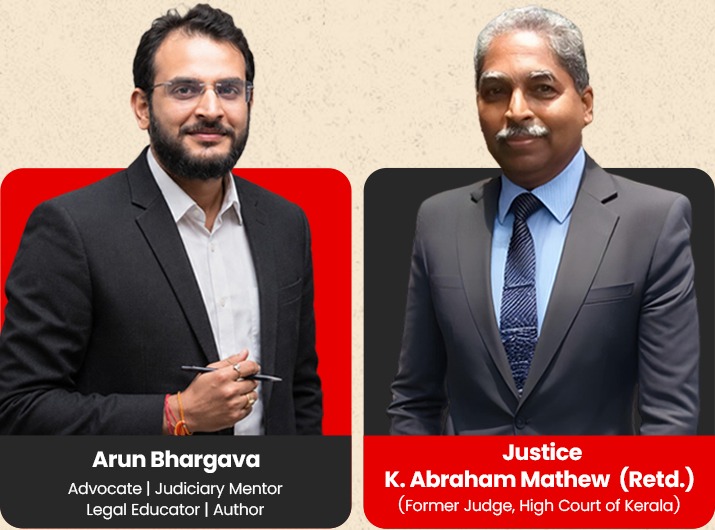
Former Judge, High Court of Kerala
Justice Mathew obtained his Law degree from Law College, Thane (University of Bombay). He joined the Judicial service in 1988 and served as the Munsiff-Magistrate. He was promoted as Sub Judge in 1992 and promoted as District Judge in 2001.
He served as the Director, Kerala Judicial Academy, from 2010 to 2012. He served as the Registrar (Vigilance), High Court of Kerala in 2012 and served as the District & Sessions Judge, from March 2013 till December 2013. He was sworn-in as the Additional Judge of the High Court of Kerala on 01-01-2014 and appointed as a Permanent Judge of the High Court of Kerala with effect from 10-03-2016. He retired on 18-01-2019.
Experience
• 1988 — Joined judicial service as Munsiff-Magistrate
• 1992 — Promoted Sub Judge
• 2001 — Promoted District Judge
• 2010–2012 — Director, Kerala Judicial Academy
• 2012 — Registrar (Vigilance), High Court of Kerala
• 2013 — District & Sessions Judge
• 2014–2019 — Judge, High Court of Kerala
Advocate & Judiciary Mentor
Arun Bhargava is an Advocate and Judiciary Mentor with over nine years of experience mentoring aspirants for Judicial Services and Assistant District Attorney examinations across India. He has guided students through every stage of the judicial services examination — Preliminary, Mains and Interview — and is known for his structured, concept-driven, examination-oriented teaching methodology.
He specialises in Procedural and Criminal Laws, including the Civil Procedure Code (CPC), Bharatiya Nagarik Suraksha Sanhita (BNSS), Bharatiya Sakshya Adhiniyam (BSA), Bharatiya Nyaya Sanhita (BNS), the Indian Evidence Act, and answer-writing for judicial services examinations. His teaching combines conceptual clarity, practical application of legal principles, landmark judgments and effective examination strategies. Over the years, his students have secured numerous top ranks and selections in Judicial Services and Assistant District Attorney examinations across different States. He is also the author of several books on Judicial Services and Higher Judicial Services preparation, covering both preliminary and mains examinations.
Experience
• 9+ years mentoring Judicial Services & ADA aspirants nationwide
• Specialises in CPC, BNSS, BSA, BNS and the Indian Evidence Act
• Author — books on Judicial Services and Higher Judicial Services preparation
• Faculty, LiveLaw Academy — substantive criminal law
How You Will Learn
Course Details
Programme Includes
Editorial Note
The enactment of the Bharatiya Nyaya Sanhita and the Bharatiya Nagarik Suraksha Sanhita marks the most significant restatement of Indian criminal law in more than a century. Much of the substantive text carries forward the earlier codes, yet the scheme, numbering and several key provisions have been reorganised.
For anyone who reads a criminal file — counsel, prosecutor, investigating officer or judge — practice now requires a working command of both codes read together, alongside the case law that will develop under them.
This programme is designed as a serious, structured reading of the new framework — not a survey, not a cram. It rewards attention and returns clarity.
Both courses are also available separately.
An In-depth Course on Bharatiya Nyaya Sanhita 2023 / Indian Penal Code
By Arun Bhargava
An In-depth Course on Bharatiya Nagarik Suraksha Sanhita, 2023 / Code of Criminal Procedure, 1973
By Justice K. Abraham Mathew (Retd.)
Combo price: ₹9,999 (incl. GST) — Save ₹1,999 compared to enrolling in both separately (₹11,998).
FAQ
Yes. Recordings of every session are made available on the course portal and remain accessible for 6 months from the last class.
Contact
Join a programme designed for practitioners, students and officers who read the codes for a living.
Enroll Now